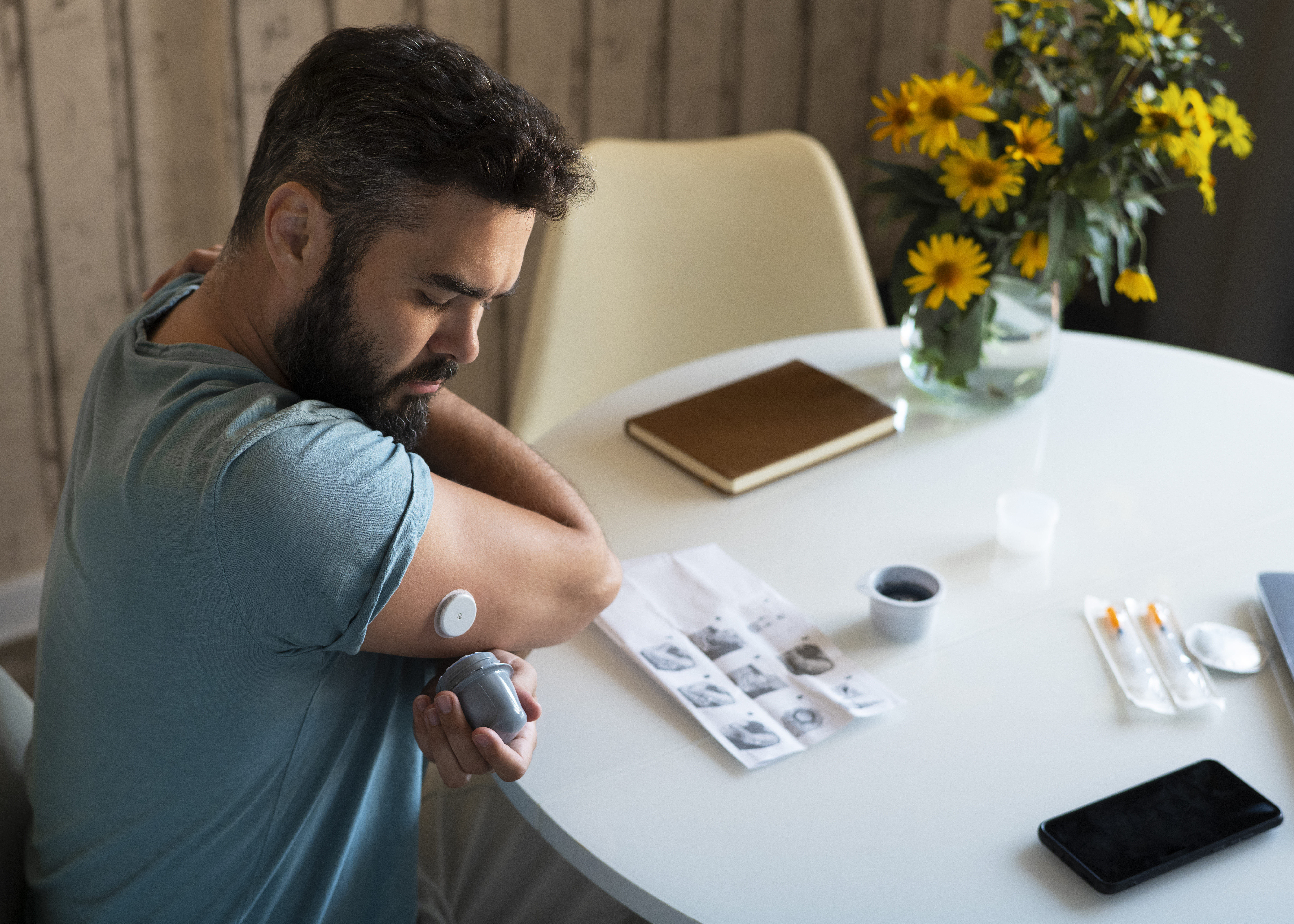
Your CGM app is beautiful. Smooth curves. Color-coded ranges. Trend arrows. It looks like you have everything under control.
But here's the truth: your CGM app is a rear-view mirror. It shows you where you've been. It does not — and cannot — tell you where you're going or what to do about it.
What a CGM App Actually Does
Let's be fair. CGM apps do important things:
- They receive glucose data from your sensor every minute (Libre 3) or every 5 minutes (Dexcom).
- They display trends visually — arrows showing direction and rate of change.
- They alert when you cross thresholds — high, low, urgent low.
- They generate reports for your endocrinologist — time in range, averages, standard deviation.
These are real, valuable functions. But they are fundamentally reactive. The app responds to data. It does not reason about it.
The Problem: Correlation Is Not Causation
Your CGM app sees that your glucose is 180 mg/dL and rising. What it cannot see — and therefore cannot tell you — is WHY.
Are you high because you under-bolused for lunch? Because your dawn phenomenon kicked in? Because yesterday's leg day is still reducing your insulin sensitivity? Because you're getting sick? Because you're stressed? Because your infusion site is failing?
The CGM shows a number. It does not show the story behind the number. And without the story, you cannot make the right decision.
A CGM app tells you 'you're high.' An AI agent tells you 'you're high because your pre-bolus was 5 minutes late, same as yesterday — try 20 minutes earlier next time, and consider that leg day might still be affecting your sensitivity.' That's the difference between data and insight.
What You're Not Seeing
Your CGM app ignores everything that isn't glucose. But glucose is the OUTPUT of a complex system. The inputs include:
- Insulin on board — not just what you took, but when it peaks and how long the tail lasts.
- Food absorption — different meals absorb at different rates. Pizza and juice are not the same.
- Exercise impact — cardio drops glucose fast. Lifting can raise it first, then drop it hours later.
- Sleep quality — poor sleep increases insulin resistance the next day.
- Stress hormones — cortisol and adrenaline directly raise glucose.
- Menstrual cycle and hormones — many women see predictable glucose shifts during their cycle.
- Illness — even a mild cold can double your insulin needs.
Your CGM sees none of this. It just sees the result. And if you're making insulin decisions based only on the result — without understanding the causes — you're essentially guessing.
The Report Problem
Every few months, you generate a CGM report for your endo. Time in range: 42%. Average glucose: 165 mg/dL. Standard deviation: 68. Your endo nods, adjusts your basal slightly, and you leave with the same problems.
The report shows WHAT happened. It does not show WHY it happened or WHAT TO DO DIFFERENTLY. It's a scorecard without a playbook.
What you actually need: pattern recognition that connects your glucose to your life. 'Every Tuesday you spike after lunch — that's your stressful team meeting. Consider pre-bolusing 10 minutes earlier on Tuesdays.' A CGM app will never tell you this.
What Open-D Does Differently
Open-D doesn't replace your CGM. It connects TO your CGM and adds the missing layer: context, memory, and reasoning.
- It correlates glucose with insulin, food, exercise, sleep, and stress — not glucose alone.
- It builds a memory of YOUR patterns: how specific foods affect you, how exercise changes your sensitivity, what your dawn phenomenon looks like.
- It warns you before problems happen — not just when you cross a threshold, but when the trend plus context suggests trouble is coming.
- It learns from your actual data — not generic rules, but your personal response curves.
Your CGM shows you data. Open-D helps you understand it. That's the difference between a chart and an agent.
If your CGM app is a speedometer, Open-D is a GPS. The speedometer tells you how fast you're going. The GPS tells you where you're going, warns you about traffic ahead, and suggests a better route. You need both — but the speedometer alone won't get you to your destination.
The Honest Bottom Line
CGM technology is one of the biggest advances in diabetes care. But the apps that come with CGMs are still basically logbooks with pretty charts. They show you what happened. They don't help you change what happens next.
If you're frustrated that your time in range isn't improving despite having the best sensor technology — the problem isn't the sensor. It's the intelligence layer on top of it.
You don't need a better chart. You need an agent that reads the chart, understands your life, and tells you what to do before the next spike happens.
Why Walking Lowers Blood Sugar But Lifting Doesn't
exercise context CGM apps completely miss
The 4 Types of Meals
why insulin timing should change based on what you eat
Ready for Your AI Diabetes Agent?
Open-D is the AI Diabetes Agent that watches your glucose 24/7, learns your patterns, and alerts you before problems happen.
Get Your AI Diabetes AgentLibre 3 · iOS & Android · Join the waitlist