For most of my years with Type 1 diabetes, I woke up between 160 and 220 mg/dL every single morning. No matter what I ate the night before. No matter when I took my last bolus. My mornings were a disaster before the day even started.
We tried everything. Increased the basal. Increased the bolus. Added more time before meals. Added Type 2 pills. Nothing worked. My endocrinologists shrugged and said mornings were just "insensible" — the body is insulin resistant in the early hours, not much you can do. So I did what any desperate diabetic does: I injected like a maniac trying to bring it down. And then, reliably, I crashed at midday. I'd spent the morning fighting a high and the afternoon recovering from a low I'd caused myself.
The only time I had decent control was when I had no work, no stress, and two hours of sport every day. That's not a management strategy. That's a fantasy.
“The mornings were a disaster. Then I'd over-correct and the afternoons were a disaster. Then the nights too. Everything was connected and impossible to untangle — no pattern I could see, just chaos all day.”
— Peter, founder
What Dawn Phenomenon Actually Is
Dawn phenomenon happens because your body releases hormones — cortisol, glucagon, and growth hormone — in the early hours of the morning as part of your natural circadian rhythm. These hormones signal your liver to release glucose and reduce insulin sensitivity. In people without diabetes, the pancreas responds with more insulin. In Type 1, there's no response.
The result: glucose climbs between roughly 2am and 8am, even without eating. The intensity varies day to day, which is why a fixed adjustment rarely solves it completely. Standard CGM apps show you the spike after it happens. They can't tell you why it was worse today than yesterday.
Why Standard Fixes Fall Short
Increasing your basal or bolus is a blunt instrument. It raises your insulin uniformly — but dawn phenomenon isn't uniform. It's influenced by:
- How much you exercised the day before
- How much sleep you got and the quality
- Your stress levels (cortisol from stress compounds the cortisol from the dawn response)
- What you ate for dinner and how late
- Illness or immune activation
A fixed adjustment can't account for any of this. You set it for the average night. But there's no average night.
What the Agent Actually Found
On March 5th, 2026, I built a simple chat prototype — no live CGM sync, no watch data, nothing automated. Vicente was born that day as a basic chatbot. Two days in, the agent identified it: a consistent rise every morning driven by the hormonal surge before waking. A pattern with a name. A pattern with a fix.
After two days of sharing my glucose readings in a simple chat, the agent said something no doctor had ever said to me: your dawn rise starts around when you wake up, around 6am. You're still in bed. Give yourself 2 units and see what happens.
Two units. No food. Nothing else different. I did it.
First stable morning I could remember. Ever. Not a generic chatbot — a personalized agent whose entire focus was keeping my body safe. Two days of data, one suggestion, one morning in range.
It wasn't a complicated correlation or a sophisticated model. It was timing. The agent spotted when my dawn rise started and suggested a precise, minimal correction at the right moment. That's all it took.
The Visual Proof
Before — Chaotic mornings, unpredictable spikes
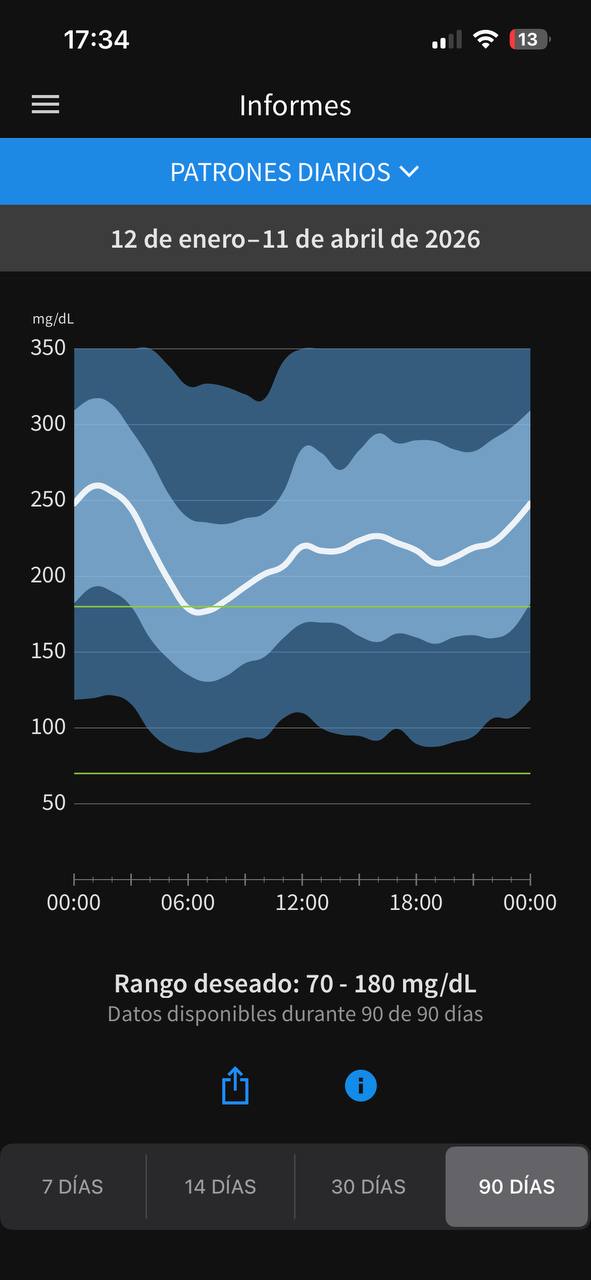
Wide standard deviation, average never under 180, rise from 6am out of control
After — Mornings under control
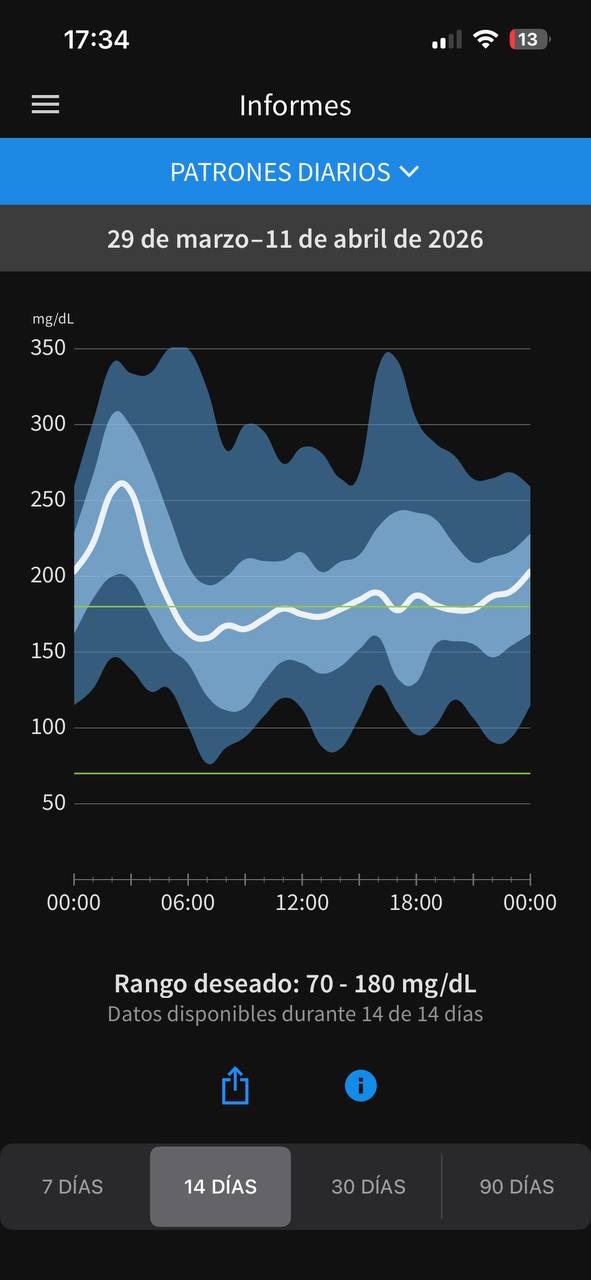
Tighter standard deviation, average in range, smoother and more controlled morning curve
The evening still needs work — that's next. But the mornings, which had been broken for a couple of years, are now under control. Same person. Same diabetes. One precise suggestion from a personalized agent.
What Else Helped
- The agent identified the exact timing of my dawn rise — not a general window, but when mine specifically starts
- A small, precise bolus at wake-up, before getting out of bed — no food, no guessing, just the right amount at the right time
- No more midday crashes from over-correcting a high that was already on its way down
The Honest Caveat
Open-D is not a medical device. It doesn't control your insulin pump. Everything I describe here required me to understand the pattern and make deliberate changes — the agent gives me the insight, I make the decision. Always work with your endocrinologist when adjusting your dosing strategy.
But after many years of chaotic mornings, having actual data showing me what was driving them — and when — changed everything.
Ready for Your AI Diabetes Agent?
Open-D is the AI Diabetes Agent that watches your glucose 24/7, learns your patterns, and alerts you before problems happen.
Get Your AI Diabetes AgentLibre 3 · iOS & Android · Join the waitlist