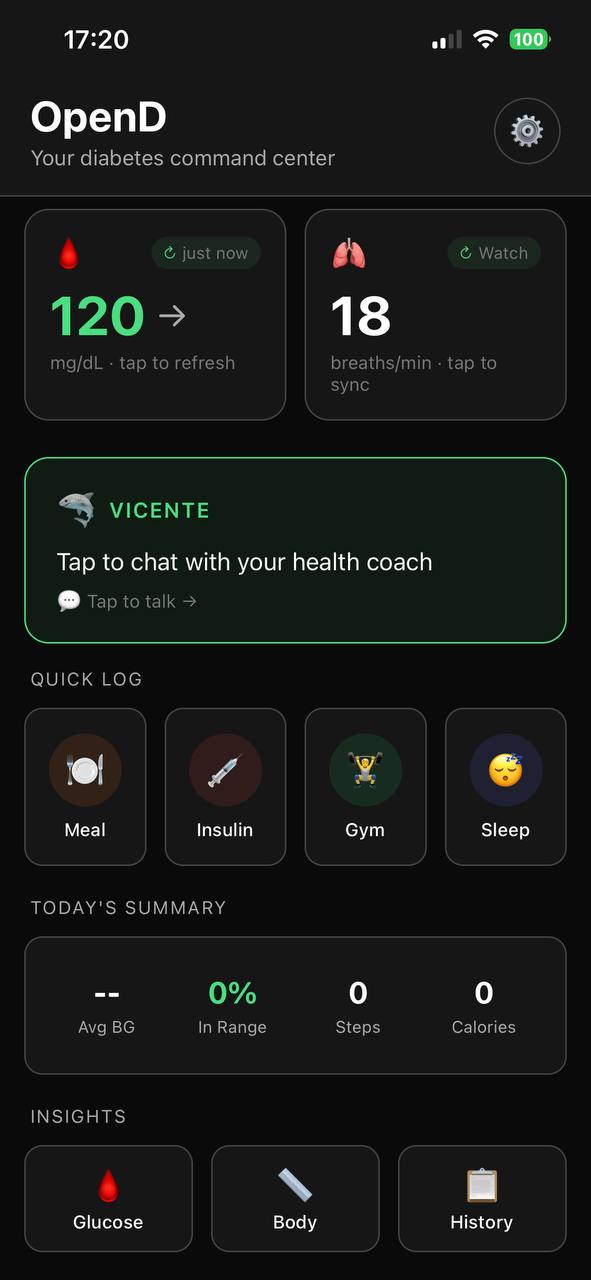
When I started building Open-D, I assumed integrating CGMs would be the easy part. I was wrong. Very wrong. What followed was months of wrestling with two completely different philosophies: one company that genuinely wants developers to build on their platform, and one that treats its API like a state secret.
This isn't a review of sensor accuracy or comfort. There are hundreds of those. This is what you don't read anywhere: what it's actually like to build a diabetes app that talks to both Dexcom and Libre, the technical compromises you have to make, and why your app's refresh rate depends on which sensor you're wearing.
The User Experience: 1 Minute vs 5 Minutes
Let's start with the obvious. Libre 3 sends glucose data every 60 seconds. Dexcom G7 sends it every 5 minutes. On the surface, this looks like Libre wins hands down. More data = better AI, right?
Actually, the 1-minute data matters more than people think. It's not about the absolute number — it's about the speed of change. Rate of change is the single most powerful signal for predicting where your glucose is heading. A 1-minute interval lets the AI see acceleration: how fast a meal spike is building, how quickly insulin is pulling you down, whether a correction is hitting too hard or too soft.
With 5-minute data, you get slope. With 1-minute data, you get curvature. And curvature is what reveals food absorption patterns and personal insulin sensitivity. The same meal can look completely different at 1-minute resolution — some foods have a sharp initial ramp, others a slow creep. The AI needs that detail to learn YOUR patterns, not generic ones.
For AI prediction, 1-minute data beats 5-minute data. Rate of change — how fast your glucose is moving — is more predictive than the absolute value. Libre's minute-by-minute resolution lets the AI see acceleration patterns that are invisible to 5-minute snapshots. That's why we built Open-D to leverage every data point.
Libre: The Cloud-First Approach
Libre 3 connects to Open-D through LibreLinkUp — the same account you use to share data with family or caregivers. You enter your email and password, select your region, and Open-D syncs your glucose data from Abbott's cloud servers.
The upside: it works even when you're away from your sensor. The Libre sensor sends data to Abbott's servers via your phone, and Open-D fetches it from there. You don't need to be near the sensor for the app to stay updated. It also means the setup is simple — one login, and data flows automatically.
The downside: you're dependent on Abbott's servers and your internet connection. If Abbott has an outage or you're offline, the data stops flowing. There's also a small lag — typically 1-3 minutes between the sensor reading and it appearing in Open-D, because the data goes sensor → phone → Abbott cloud → Open-D.
Dexcom: The Fortress
Dexcom's approach is the opposite. They have a public API — the Dexcom Share API — but it's designed for caregivers, not apps. To get production access, you have to apply through a partnership program. We applied. We never heard back.
The sandbox API is available for testing. It works. You can authenticate, pull data, build your integration. But you can't ship it to real users without production approval. And production approval requires filling out a form that asks questions like: 'On what servers do you store user data?'
Here's the problem: we don't store user data on any server. Open-D is privacy-first. Everything is on-device. The form doesn't have an option for 'no server.' It assumes you're a cloud company harvesting health data. We can't even complete the application honestly.
Dexcom's partnership form is built for traditional health-tech companies that centralize data. It has no conception of a privacy-first app that keeps everything local. We literally cannot fill out their form without lying or restructuring our entire architecture to be less private.
How Open-D Connects to Dexcom
Open-D offers two ways to connect your Dexcom G7. You choose which one works better for you.
Direct Connect is the recommended option. You log in with your Dexcom account (the same one you use in the Dexcom app), pick your server region — US, EU/International, or Japan — and Open-D pulls fresh glucose data directly from Dexcom every 5 minutes. It's the same approach Nightscout and xDrip use. No setup in the Dexcom app required beyond having an account.
The second option is via Apple HealthKit or Google Health Connect. You grant Open-D permission to read glucose data, and the Dexcom app writes its readings to HealthKit/Health Connect automatically. This sounds simpler, but there's a catch: on Android, Dexcom data through Health Connect can be delayed by 2–3 hours. That's too slow for real-time AI. On iOS it's faster, but still not as immediate as Direct Connect.
Both Dexcom options require internet. If you're offline, glucose data doesn't flow. This is the reality of Dexcom's ecosystem — there's no way around it without official API access, which they don't grant to apps like ours.
The Heating Period: 30 Minutes vs 60 Minutes
Here's something that affects your daily routine: Dexcom G7 takes 30 minutes to warm up. Libre 3 takes 60 minutes. When you're switching sensors — usually first thing in the morning — that's the difference between having glucose data before breakfast or flying blind through your first meal.
Both apps show a countdown during warmup, but you can't make AI-driven insulin decisions without fresh glucose data. During that window, you're back to manual mode: checking how you feel, estimating based on your last reading before the switch, and being more conservative with doses until the new sensor comes online.
Why Every CGM Needs a Different Connection
We didn't set out to build multiple connection methods. We wanted one simple flow: you connect your CGM, and data appears. But the reality is that Dexcom and Abbott approach third-party access completely differently — and neither gives us a perfect solution.
Libre connects through LibreLinkUp, Abbott's cloud service. It's straightforward: one login, and data syncs. But you're tied to Abbott's servers and your internet connection. Dexcom connects through Share API (Direct Connect) or HealthKit/Health Connect. Direct Connect gives you real-time 5-minute updates, but again — internet required. HealthKit is more 'official' but can be hours behind on Android.
For you as a user, this means: if you want the fastest, most reliable data in Open-D, use Dexcom with Direct Connect. If you want simplicity and don't mind a small server delay, Libre works great. Both keep your credentials stored only on your device — we never send them anywhere except to the respective CGM company's own servers.
The Honest Verdict for T1Ds
If you care about AI-powered insights, Libre 3 has an edge: the 1-minute data resolution. Rate of change is the most predictive signal for glucose forecasting, and 1-minute intervals capture acceleration patterns that 5-minute data misses entirely. For pattern recognition — learning how YOUR body reacts to specific foods, insulin doses, and exercise — that granularity matters.
Dexcom makes a great sensor. The G7 is accurate, reliable, and the 30-minute warmup is genuinely better. Their Direct Connect gives you real-time 5-minute updates that are solid for day-to-day management. But their developer ecosystem is stuck in 2015. They treat their API like a competitive moat instead of a platform. And that hurts innovation.
We support both because our users wear both. But if Dexcom ever offered 1-minute resolution and an open API, it would be the best of both worlds. Until then, if AI-driven pattern recognition is your priority, Libre's data granularity gives you an advantage.
If you're a Dexcom user, write to them. Ask why a privacy-first diabetes app can't get API access. Ask why their partnership form assumes every developer wants to hoard your health data on their servers. User pressure is the only thing that will change this.
What Is an AI Diabetes App, Really?
how real-time CGM data feeds into AI decision-making
Open-D v2.0.0 — Dexcom Integration Is Live
how we shipped direct Dexcom Share API support